Product Description
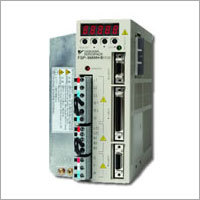
Servo Drive Amplifier has been specifically designed to be used for amplifying current signals in response to command given by user. It is required for powering electric servomechanisms and transmitting electric signals to servo motors. This amplifier is known to work by detecting actual status of motor with help of a sensor and then altering pulse width or voltage frequency accordingly. It is completely suitable to be used in factory automation, robotic systems, and CNC machining for increasing their reliability & operating efficiency. Servo Drive Amplifier comprises four main components including motor, drive, controller, & feedback device.
Technical Specification
| Dimension | 6.3 inch Height x 2.95 Inch Width x 5.1 Inch Depth |
| Brand | Yaskawa |
| Model Name/Number | Sigma II |
| Speed Range | 1500 to 3000 RPM |
| Input Voltage | 110, 200 and 400 VAC, 1 PH & 3 PH |
| Input Phase | Both Single & Three Phase |
| Power Rating | 400 watt |
| Input Frequency | 40 Hz |
Efficient Motor ControlOur Servo Drive Amplifier provides accurate and responsive control for various motors in automation and robotics. With a 400W power capacity, it ensures smooth and reliable operation, minimizing downtime and enhancing productivity. Its precise voltage regulation makes it suitable for demanding applications.
Durable & User-Friendly DesignConstructed with high-quality ABS plastic and weighing only 2.5 kg, this amplifier combines strength with portability. The sleek white color blends seamlessly into any workspace, and its compact build simplifies installation and maintenance for users of all experience levels.
Hassle-Free Warranty and SupportEvery purchase is backed by a 1-year warranty, demonstrating our commitment to customer satisfaction. Our support team, located in India, is ready to help with any installation or operational queries, ensuring a smooth ownership experience from start to finish.
FAQs of Servo Drive Amplifier:
Q: How do I install the Servo Drive Amplifier in my automation system?
A: To install the Servo Drive Amplifier, mount it in a secure location with proper ventilation, connect the motor and power supply as per the provided wiring diagram, and ensure all safety measures are followed. Refer to the user manual for detailed, step-by-step instructions.
Q: What are the benefits of using an ABS plastic body for this amplifier?
A: ABS plastic offers durability, resistance to impact, and a lightweight profile. This ensures the amplifier is robust enough for industrial environments while remaining easy to handle and install, all without compromising electrical safety.
Q: When should the amplifier be serviced or checked for maintenance?
A: Routine maintenance checks are recommended every six months or as per usage intensity. Inspect for dust accumulation, loose connections, and any physical damage to ensure optimal performance and longevity.
Q: Where can I purchase spare parts or obtain technical support for the amplifier?
A: Spare parts and technical support are available through our authorized suppliers across India. You can also contact our customer service center for prompt assistance and guidance on product-related issues.
Q: What is the process to claim the 1-year warranty if needed?
A: If warranty service is required, contact your point of purchase with the product details and proof of purchase. Our team will guide you through the process, offering repair or replacement as per the terms and conditions.
Q: How is the Servo Drive Amplifier typically used in industrial applications?
A: This amplifier is primarily used to provide precise control and regulation in industrial motor systems. It helps maintain consistent motor speed, enhances automation processes, and ensures safe operation by protecting against voltage fluctuations.
Q: What are the advantages of a 400W, 220V Servo Drive Amplifier?
A: A 400W, 220V configuration delivers ample power for most medium-duty industrial applications while maintaining energy efficiency. Its suitable for diverse industrial settings, providing both performance and cost-effectiveness.



 Send Inquiry





 Send Inquiry


 Send Inquiry
 Send SMS
 Call Me Free


