

Call Us Now08045802907
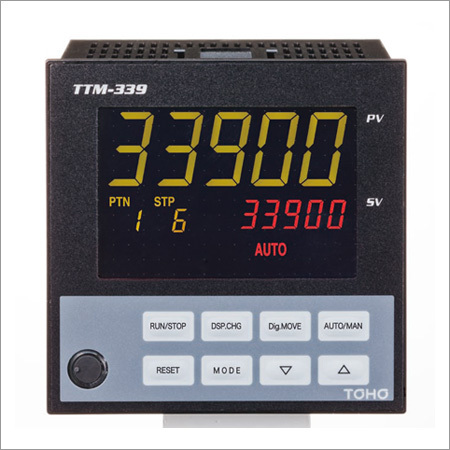
Digital Process Controller is specifically designed for offering high accuracy control of different process. Thereof, this is widely used in diffusion and conveyor furnaces. It is well accepted in the market for offering a versatile way of automating the diffusion process. The controller is engrossed with user friendly programmed functions that make it well appreciated for easy accessibility. We are designing this range with advanced machine and quality tested materials in adherence to set quality standards. Digital Process Controller is easily accessible to our clients at economical rates.
Advantages:
Compact size program controller with high functionality and high performance
Features :
High functional, performance oriented and compact size digital program controller, that features:
Specifications of Program Controller: One can find 15 patterns and 99 steps in a liquid crystal display program controller.
Full Multiple Inputs: There are total 13 types of thermocouple inputs, which include:
A liquid crystal display:
Backup and Initialization for the Setting Value :
Communication function (RS485: TOHO exclusive protocol / MODBUS):
Function :
|
Program specifications |
Output in operation/End signal output selectable and configurable |
||
|---|---|---|---|
|
External drive signal selection |
Internal operation, external operation |
||
|
Temperature range setting for power failure recovery |
Temperature input |
0.0 to 2999.9, 0 to 2999(oC) |
|
|
Analog input |
0 to 2999 (digit) |
||
|
Timer specifications |
Setting unit |
1 min |
|
|
Setting time |
0 to 99 hrs 59 min |
||
|
Setting accuracy |
+(0.5% +0.5 sec) of setting time |
||
|
Manipulated variable |
Manipulated variable function selection (MLF) |
None, Manipulated variable limiter, manipulated variable current limiter |
|
|
Manipulated variable limiter |
Upper limit |
MLL1 to 100.0 (%), MLL2 to 100.0(%) |
|
|
(MLH1 to MLH4) |
MLL3 to 100.0(%), MLL4 to 100.0(%) |
||
|
Lower limit |
0.0 to MLL1(%), 0.0 to MLL2(%) |
||
|
(MLL1 to MLL4) |
0.0 to MLL3(%), 0.0 to MLL4(%) |
||
|
Manipulated variable change |
Percentage of rise for manipulated variable |
0.0 to 549.9(%)(0.0% : function OFF) |
|
|
limiter rise |
Rise time of manipulated variable |
0 to 3600 (sec) (0: function is none) |
|
|
Setting limiter (SLL), (SLH) |
Upper limit (SLH) |
Temperature input |
(SLL+5.0) to SV setting range upper limit, (SLL+5) to SV setting range upper limit (oC ) |
|
Analog input |
(SLL+50) to SV setting range upper limit (digit) |
||
|
Lower limit (SLL) |
Temperature input |
SV setting range lower limit to (SLH-5.0), SV setting range lower limit to (SLH-5)(oC ) | |
|
Analog input |
SV setting range lower limit to (SLH-50) (digit) |
||
|
Scaling setting |
Upper limit (FSH1) |
FSL1 to 29999 (digit) |
|
|
(Analog input only) |
Lower limit (FSL1) |
19999 to FSH1 (digit) |
|
|
Control type (CNT) |
PID control, ON/OFF control |
||
|
PV correction gain setting (PVG) |
0.500 to 2.000 (times) |
||
|
PV correction zero setting (PVS) |
Temperature input |
999.9 to 999.9, 999 to 999(oC ) |
|
|
Analog input |
9999 to 9999 (digit) |
||
|
PV filter setting (PDF1) |
0.0 to 99.9 (sec) |
||
|
Special PV filter setting (PDFS) |
0.0 to 99.9 (sec) |
||
|
Anti reset windup |
0.0 to 110.0 (%) (Function OFF by 110.0% setting) |
||
|
Manual reset |
0.0 to 100.0 (%) (100.0 to 100.0 (%) if there is auxiliary control) |
||
|
Main control loop abnormal |
PV variation setting |
Temperature input |
0.0 to 999.9, 0 to 999 (oC ) |
|
Analog input |
0 to 9999 (digit) (The decimal point position is the specified position.) | ||
|
Time setting |
0 to 3600 (sec) |
||
|
Decimal point position setting |
Temperature input |
1oC , 0.1oC |
|
|
(DP) |
Analog input |
1/digit, 0.1/digit,0.01/digit, 0.001/digit, 0.0001/digit |
|
|
Lock function (LOC) |
Normal screen, pattern No. setting mode, alarm temperature setting mode, PID setting mode, common parameter setting mode (SET1 to 12), setting temperature (all steps at one time), wait function setting (all steps at one time), time signal 1 to 4 function setting (all steps at one time), manipulated variable limiter function setting (all steps at one time), setting time (all steps at one time), end signal ON time |
||

Price:
GST : 24AAACM7953M1Z3
 Send Inquiry

|





 Send Inquiry


 Send Inquiry
 Send SMS
 Call Me Free


