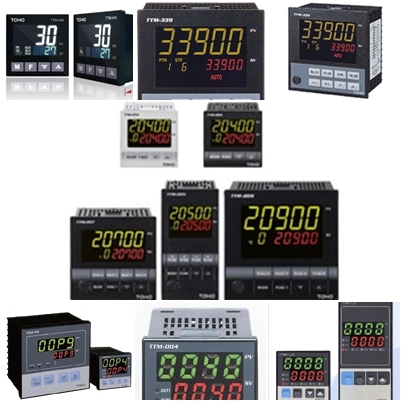
Since our inception in the year 1992, we have been known as a profound manufacturer and supplier of optimum quality Proportional Integral Derivative controllers. Manufactured with the aid of precision components, these controllers are known for their user friendly interface and accurate measurement. These controllers find their important usage in process control systems for detection and fixation of errors. Also, our clients can purchase these PID controllers at reasonable prices from us.
Features:
- Efficient error measurement and control
- Power efficient
- Long service Life
-
Clear display
PID Controller
A proportional integral derivative controller is a control loop feedback controller, that is mainly applicable in industrial control systems. This controller is given this name from its operations. This instrument is used for calculating an error value as the difference between a measured process variable and a desired set-point. The correction is applied on the bases of P (Proportional), I (Integral) and D (Derivative). It can regulate speed, flow, pressure, temperature, and other process variables. It can be used with control regulation device or sensor and can be monitored with SCADA System.
Industrial controller development
The foremost automatic PID process controller was pneumatic device, which used compressed air to calculate the controller output and power the process modulating device. It was also used in harsh industrial environment. It was used till the advent of discrete electronic controller and distributed control system. Complex electronic systems used electronic analog PID control loops. The advent of digital controller replaced electronic controller. Currently, modern PID controllers are used in the industry and can be found in Distributed Control Systems (DCS) and PLCs. PID temperature controllers are used in plastic injection molding machine, hot stamping machine, industrial oven and even in packaging industry. This device is an indispensable part of multirotor drones, and act as a self-stabilizing flight controller.
Temperature Control using a Digital PID controller
The common use of proportional integral derivative temperature controller is to alter a process temperature by continuously varying a regulator. It can be used as a pulsed switching device for opening/closing gas valve or electrical heater. PID temperature controller-heat only, operates at a reverse output action, which means, it applies more power when the temperature is under the set-point and less power when higher the set-point. In injection and extrusion applications, PID controller employ additional cooling control outputs and multiple controllers.
This controller can be termed as three term controller based on its function. It reads the sensor signal from RTD or thermocouple, converts the measurement to engineering units like Degrees Celsius; and lastly subtracts the measurement from a desired set-point. to identify an error. The determined error is then acted upon by the three (P, I & D) terms simultaneously. It is also called PID Controller Theory:
- Proportional (Gain): In case of reverse action, the error gets multiplied by a negative proportional constant P, and added to the current output.
- Integral (Reset): The concluded average error is multiplied by a constant I, and added to the current control output.
-
Derivative (Rate): With respect to time, rate of change of the error is determined, multiplied by constant D, and added to the output. Through derivative term, response of controller to a change or disturbance of the process temperature is determined. The controller responds to changes in process value more rapidly, if the derivative term is larger.
Tuning of PID Controller Terms
Tuning of P, I and D terms is essential to match the dynamics of the process being controlled. Stability or instability, fast control or slow control; all depends of setting of any of these terms. Correct setting can lead to stable and fast control. The digital PID controllers have in-built, automatic auto-tune functions. During auto-tuning, PID controller controls the process power and determines the rate of change, overshoot and response time of the plant. The calculations of controller term values are often based on the Zeigler-Nichols calculation method. After the auto-tuning period, P, I & D values are stored and used by the PID controller.
Specification:
- Sizes ranging from 1/4, 1/8, 1/16
- Theory: Temperature Controller
- Isolation: 2300VDC
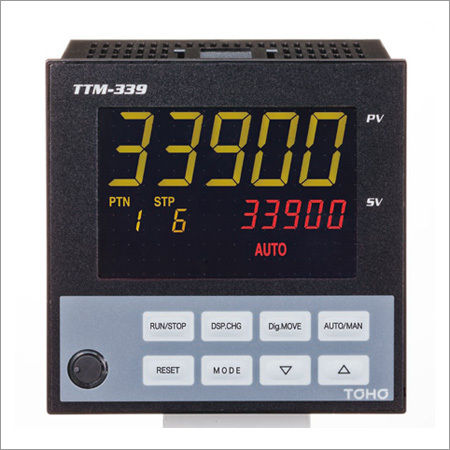
Featuring a clear 4-digit digital display, our PID controllers enable operators to monitor temperature or process variables with high readability. The intuitive interface allows quick parameter adjustments, contributing to seamless system management.
Designed for standard panel installation, these controllers fit securely using screw terminals. The compact, robust build (96 x 96 x 100 mm) ensures durability and effortless integration into control panels across various industries.
Boasting 0.1% accuracy, these controllers guarantee exceptional process regulation. Whether your application requires relay or SSR output, our controllers adapt to your needs for optimal system performance.
FAQs of PID Controllers:
Q: How is the PID controller installed in an industrial panel?
A: The controller is designed for panel mount installation. Simply fit it into a 96 x 96 mm panel cutout and securely connect the wiring using the screw terminals provided, ensuring a firm and reliable setup.
Q: What types of output does this PID controller support?
A: This model accommodates both relay and SSR (Solid State Relay) outputs, providing flexibility to match various process control requirements and enabling integration with different actuator systems.
Q: When should I use a PID controller with a 0.1% accuracy rating?
A: A PID controller with 0.1% accuracy is ideal when precise temperature or process control is essential, such as in laboratory, pharmaceutical, or manufacturing environments where minute deviations can affect outcomes.
Q: Where are these PID controllers manufactured and supplied?
A: We manufacture and supply these PID controllers in India, offering local support and rapid delivery across the region to meet domestic industrial automation needs.
Q: What is the benefit of the 4-digit digital display?
A: The 4-digit digital display provides sharp, easily interpretable readings, allowing operators to adjust and monitor process parameters efficiently, reducing errors and improving operational insight.
Q: How does the controller maintain consistent performance over time?
A: Maintaining high accuracy and leveraging PID control logic, the controller continuously adjusts the output to keep process variables stable, ensuring reliable, ongoing operation in demanding industrial settings.



 Send Inquiry







 Send Inquiry


 Send Inquiry
 Send SMS
 Call Me Free


